
Why blood pressure readings change during the day
Blood pressure changes with time of day, activity, stress and measuring conditions. A consistent routine helps separate a real pattern from ordinary variation.
Updated 3 min read
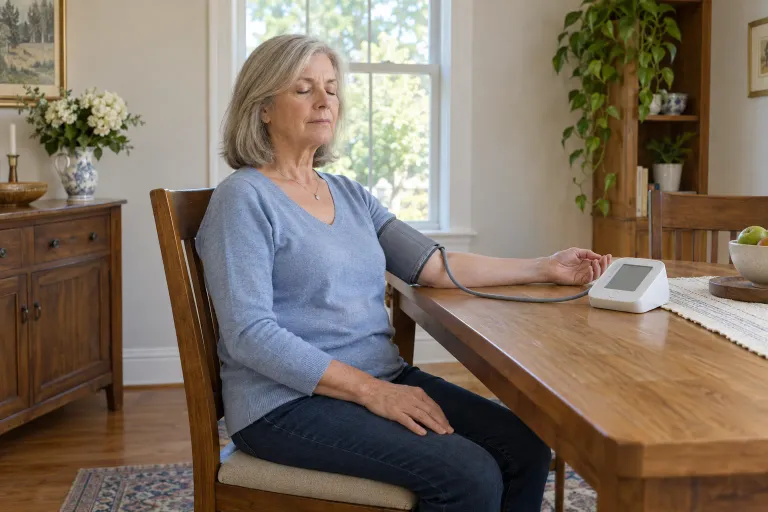
Blood pressure is not fixed. It changes during the day in response to sleep, activity, stress, meals and the conditions in which you measure it. The Dudley Group NHS Foundation Trust explains that day-to-day and hour-to-hour variation is normal and that blood pressure can be affected by anxiety, diet, exercise, sleep and medicines.
Variation is the reason clinicians look at a series rather than choosing the highest or lowest number in a diary.
Why two readings can differ
Two readings taken a minute apart are still two separate moments. Your breathing may have settled, your arm may be better supported or the cuff may sit slightly differently. The second result is not automatically the “correct” one and the first is not a mistake to delete.
NICE NG136 expects variation. In a clinic, if the second measurement is substantially different from the first, NICE advises taking a third and recording the lower of the last two. At home, NICE asks for two consecutive seated readings at least one minute apart and uses the average from several days.
What can move a home reading
Recent activity and measuring technique can alter the result. The British and Irish Hypertension Society diary instructions ask you to sit quietly for five minutes, keep both feet flat, support the arm at heart level and avoid talking while the monitor runs. How to check blood pressure at home explains the full routine.
The British Heart Foundation also stresses an upper-arm cuff that fits and a consistent routine. A cuff that is the wrong size can bias the result rather than merely add harmless noise.
Add a note when the usual routine changes. “Just walked upstairs”, “phone rang during reading” or “arm unsupported” can explain why one row stands apart from the rest. Do not adjust the number yourself. Keep the value the monitor showed and keep the note beside it.
Why the GP surgery result can be different
NICE defines a white-coat effect as a difference of more than 20/10 mmHg between clinic readings and the average from home or ambulatory monitoring at the time of diagnosis. It also describes masked hypertension, where clinic readings are not high but out-of-clinic readings are.
Neither pattern can be identified from one home result. They are reasons to compare measurements from different settings using a proper home series or a 24-hour monitor.
Build an average that can be compared
For home blood pressure monitoring, NICE recommends two consecutive readings at least one minute apart, twice daily, ideally morning and evening. Continue for at least four days and ideally seven. Discard the first day’s readings and average the rest.
The average blood pressure calculator can summarise that series, and the printable blood pressure diary provides a paper layout. Use the same arm, position and approximate times unless a healthcare professional has told you otherwise.
An average does not erase useful detail. Keep every reading so your GP can see whether a high average reflects a steady pattern or a handful of unusual sessions.
When a change needs advice
Contact your GP surgery about a pattern of high home readings. If a very high result remains after a careful repeat and you have no emergency symptoms, seek same-day advice from the surgery or NHS 111. The NHS high blood pressure page provides routes for getting a check and urgent help.
Call 999 for a life-threatening emergency such as chest pain that does not go away, severe difficulty breathing or signs of stroke. Do not delay the call to take another measurement.
BP Diary keeps each cuff reading with its time, pulse and notes, then shows averages for the period you choose. It does not decide why a reading changed. The diary gives you and your GP a clearer record to discuss.