
Can you check blood pressure without a cuff?
A phone can produce an estimate, but a validated upper-arm monitor provides the measurement used for home blood pressure records.
Updated 3 min read
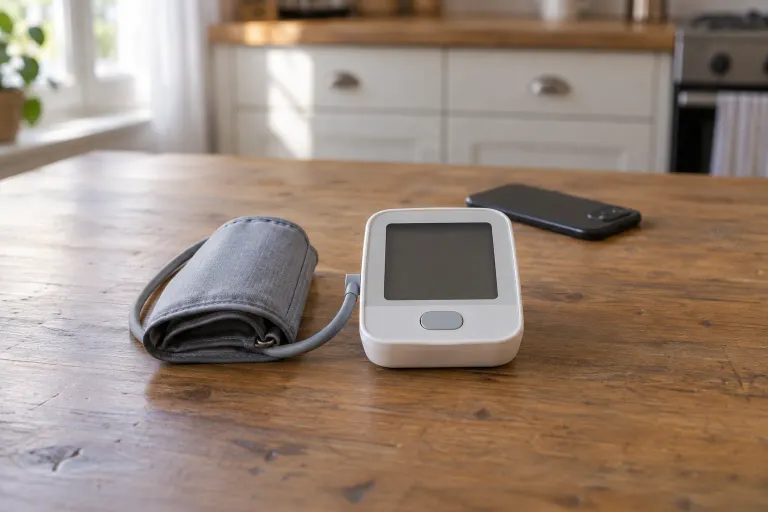
Not as a replacement for a monitor. A pulse check cannot give systolic and diastolic pressure, and a phone camera result is an estimate rather than a cuff measurement. After calibration, BP Diary can save a camera estimate, but it remains labelled separately and should not fill a record your clinician asked you to take with a monitor.
What does not work
Feeling your pulse at the wrist or the neck tells you how fast your heart is beating. It says nothing about the force of the blood against your artery walls, which is what blood pressure is. Counting beats gives you a pulse, not a reading.
For a home record, use a validated monitor with a cuff that fits the upper arm. The British and Irish Hypertension Society maintains a list of validated devices for personal use in the UK.
What the research says about phone apps
An American Heart Association scientific statement reviewed phone-based techniques and found that most had not been through validation studies. That is a specific evidence review, not a claim that every future technology will perform in the same way.
The practical distinction is still clear. A cuff monitor gives a measurement. A camera can give an estimate. Calibration may personalise an estimate, but it does not guarantee accuracy or turn the camera into a blood pressure monitor.
Wrist and finger devices
Some wrist devices do use a cuff, but position matters much more because the wrist must be held at heart level. Finger devices and cuffless wearables are different again. BIHS currently validates conventional arm and wrist-cuff monitors, and says it does not yet endorse cuffless wearable blood pressure devices.
For a straightforward home diary, choose a validated automatic upper-arm monitor with the correct cuff. The cuff size guide explains how to measure your arm before buying.
What a calibrated camera estimate is
BP Diary can save a blood pressure estimate from your phone’s camera. Calibration uses a cuff reading before and after a camera scan to personalise those estimates. An estimate does not replace a cuff measurement. You can also use BP Diary simply to record readings from your monitor.
BP Diary is not a medical device. It does not diagnose, treat, cure or prevent any condition. Camera readings are estimates powered by Shen’s face scan technology. Calibrate them against your cuff and confirm important readings with a cuff. Talk to your GP or another healthcare professional about your readings.
If you choose to save camera estimates, keep treating them as estimates. Calibrate them against your cuff, and confirm any reading that matters with the cuff before you act on it or share it with your GP.
If you have no cuff at all today
Arrange a cuff measurement. In England, the NHS pharmacy blood pressure service offers free checks to eligible people aged 40 or over who do not already have diagnosed high blood pressure. Eligibility and services differ elsewhere in the UK, so ask a pharmacy or GP surgery what is available locally.
For ongoing home monitoring, arrange regular access to a validated automatic upper-arm monitor with a cuff that fits. Price, borrowing schemes and local availability vary. Keep camera estimates separate from any series requested by your GP.
What your GP may use
NICE NG136 uses cuff readings to confirm hypertension: a clinic result of 140/90 or higher together with a home or daytime average of 135/85 or higher. It asks for two seated readings at least one minute apart, morning and evening, for at least four days and ideally seven when home monitoring is used. Follow the plan your clinician gives you.
The printable blood pressure diary collects the week and the average blood pressure calculator does the arithmetic. A cuff is on that path either way, so the useful question is not how to avoid one but which one fits your arm.