
Blood pressure cuff size chart: measure your arm first
The four adult cuff sizes with their arm circumference ranges, how to measure your own arm, and what a cuff that is too small does to your readings.
Updated 4 min read
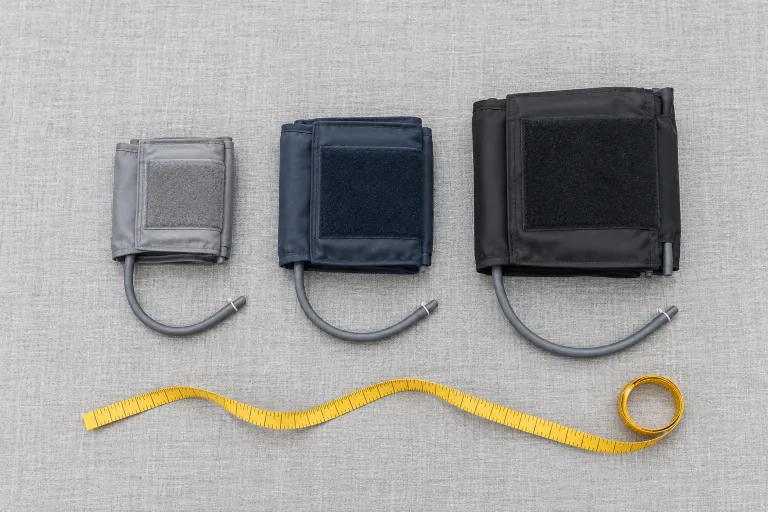
Measure around the middle of your upper arm with a tape, then find that number in the table below. From 22 to 26 cm you need a small adult cuff, from 27 to 34 an adult, from 35 to 44 a large adult, from 45 to 52 an extra-large. A cuff that is too small reads high. Undercuffing large arms is the most common cuff-size error in office blood pressure measurement.
How to measure your arm
Bare the upper arm and let it hang relaxed at your side. Put a tape measure around the arm at its midpoint, halfway between the point of the shoulder and the point of the elbow, which is where the American Heart Association measurement statement puts it: the midpoint of the acromion and olecranon. Snug, not tight, and not over a sleeve.
Write the number down. It changes slowly, and it is the measurement you need to choose the correct cuff size.
The chart
| Cuff size | Arm circumference |
|---|---|
| Small adult | 22 to 26 cm (8.7 to 10.2 in) |
| Adult | 27 to 34 cm (10.6 to 13.4 in) |
| Large adult | 35 to 44 cm (13.8 to 17.3 in) |
| Extra-large adult | 45 to 52 cm (17.7 to 20.5 in) |
Those are the illustrative sizes in the American Heart Association’s statement, which gives them in centimetres; the inches are converted, so measure in centimetres if your tape has them. One caveat comes from the same table: bladder and cuff size may differ by manufacturer. So when your own cuff prints a range on it, that range wins over any chart, and the statement says cuffs should be labelled with the arm circumferences they fit.
Behind the table is a rule rather than a set of products: the cuff’s bladder should be 75 to 100% as long as your arm’s circumference, and 37 to 50% as wide.
What a wrong size does to your readings
It moves the number in a predictable direction. The American Heart Association statement says a cuff that is too small produces an artificially high reading, while one that is too large produces an artificially low reading.
The scale of the problem is in the AHA statement: the most frequent error in measuring blood pressure in the office is miscuffing, and undercuffing large arms accounts for 84% of it. If your arm is 38 cm and the box came with an adult cuff for arms up to 34, the cuff can distort a whole week of readings. The blood pressure calculator cannot correct that measurement error, and neither can averaging.
When you are between sizes
Use the arm range printed on the specific cuff. If your arm measures 34 or 35 cm, check which range includes it instead of guessing from a label such as medium or large. If no listed range fits, ask the manufacturer or your clinician which cuff is compatible with your monitor.
Wearing it right
On bare skin, says the AHA statement, and take the sleeve off rather than rolling it up, because a rolled sleeve creates a tourniquet effect above the cuff. The lower edge of the cuff sits 2 to 3 cm above the bend of the elbow, with the middle of the cuff at heart level. How to check blood pressure at home has the rest of the routine.
Note the arm and monitor you use at the top of your log, so nobody has to guess later. The printable blood pressure log has a line for each.
Checking your cuff against the clinic’s
Take the monitor to your next appointment. The American Heart Association suggests doing that with a new device and then once a year, so the readings can be compared with the equipment in the office. In the UK, NICE NG136 holds clinics to the same rule you are applying at home: use a cuff size appropriate to the person’s arm.
BP Diary records readings from your monitor. Photograph the display and check the numbers, or enter them yourself. If you also use camera estimates, calibrate them with your cuff and confirm important readings with it.