
How to keep a blood pressure log your doctor can use
What to write down, how to follow your clinician's schedule and how the UK NICE routine handles its first day, with paper and app options.
Updated 4 min read
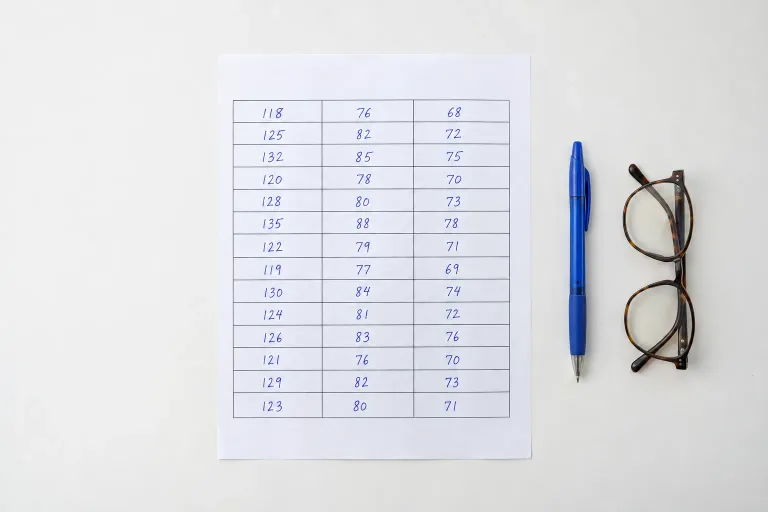
Write down every reading with its date, its time, both numbers and your pulse. Follow the schedule your clinician gives you. When that schedule is the UK NICE home-monitoring routine, it uses morning and evening pairs for four to seven days and averages everything after the first day.
What to write in each line
One line is one reading: the date, the time, the systolic number over the diastolic number, the pulse, and a word of context when something was unusual, such as a missed dose, a late night or a walk up the stairs before you sat down.
The American Heart Association asks you to take two readings one minute apart each time and record both. Both go in the log; do not keep the lower one and drop the other. The printable blood pressure log has a line for each of the two, morning and evening, for seven days.
How many readings make a log
For the UK pathway, NICE NG136 uses two consecutive seated readings at least one minute apart, recorded twice a day, ideally in the morning and evening, for at least four days and ideally seven. That is 28 readings over a full week, or 16 over the shortest series NICE accepts.
Take them at the same times every day. A morning reading and an evening reading tell the doctor different things, and a log that mixes noon one day with midnight the next hides the pattern. How to check blood pressure at home covers the routine around each reading.
Why UK NICE leaves out the first day
NICE NG136 leaves the first day out of its home-monitoring average. Keep those readings in the log and mark them as day one, then exclude them when calculating the NICE average. Other care plans may use a different method, so follow the instructions you were given.
What the average means
Average the systolic numbers and the diastolic numbers separately. For a seven-day UK NICE series, enter days two to seven in the average blood pressure calculator. For another schedule, enter the readings your clinician tells you to include.
At home, ESC 2024 calls an average non-elevated only when systolic is below 120 and diastolic is below 70 mmHg. Hypertension starts when systolic reaches 135 or diastolic reaches 85; the band between is elevated. In the UK pathway, NICE NG136 also requires a clinic result at or above systolic 140 or diastolic 90 to confirm a diagnosis. For a single reading, the blood pressure calculator shows the range and the next step.
A single high reading is not an immediate cause for alarm, as the American Heart Association puts it. Log it, sit for a minute, measure again and log that too. If the initial systolic reading was higher than 180 or the initial diastolic reading was higher than 120, compare the repeat with the same thresholds. If either repeated value remains above its threshold, contact a healthcare professional immediately. If either initial value was above its threshold and you have chest pain, shortness of breath, back pain, numbness, weakness, a change in vision or difficulty speaking, call emergency services without waiting to retest.
Paper, spreadsheet or app
A printed sheet works for one week. It fits the columns the doctor reads, it goes in a bag, and it needs nothing but a pen. Print the blood pressure log as a page or download it as a PDF.
A spreadsheet works for longer. It needs a column for each number, an averaging formula that matches your care plan and the discipline to open it on schedule. If you are following UK NICE, configure the formula to exclude the first day.
BP Diary keeps your readings with their date, time and notes. Photograph your monitor’s display and check the numbers, or type them yourself. Choose a period to see averages and print or share a report.
Bringing the log to the appointment
Bring the sheet or the app’s report. MedlinePlus says it plainly: if you monitor your blood pressure at home, keep a written record and bring the results to your office visit.
Bring the cuff as well. The American Heart Association suggests taking a new monitor to the next appointment, and bringing it in once a year after that, so the doctor can compare it against the equipment in the office.
Then keep going. The next visit compares this week’s average with the last one, and a log that continues is the one that shows whether anything changed.